dedicated to the 140th anniversary of the birth of Stasys Šalkauskis
Student at the University of Fribourg in Switzerland
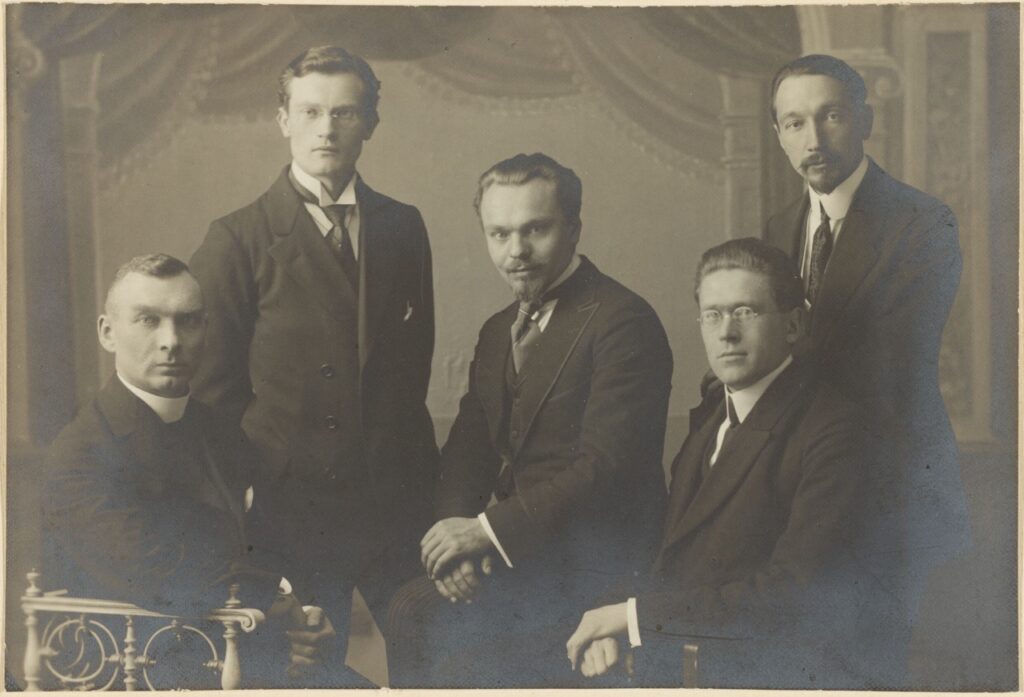
Stasys Šalkauskis (second row, first from the right) among his Lithuanian fellow students in Fribourg. Ca. 1920. Seated from the left: Juozas Dabužis, Kazys Pakštas, Izidorius Tamošaitis. Standing from the left: Vincas Mykolaitis-Putinas and Stasys Šalkauskis. Photographer unknown. Šiauliai "Aušros" museum.
In 1916–1920, Stasys Šalkauskis studied philosophy at the University of Fribourg in Switzerland. At that time, the university was Catholic in orientation. It was renowned as an important intellectual centre of European Catholicism, and the social and economic sciences taught there were based on Christian teaching. While studying at the university, Šalkauskis became acquainted with neo-scholasticism. He embraced the ideas of Thomistic philosophy, considered them to be correct, and believed they provided answers to many questions.
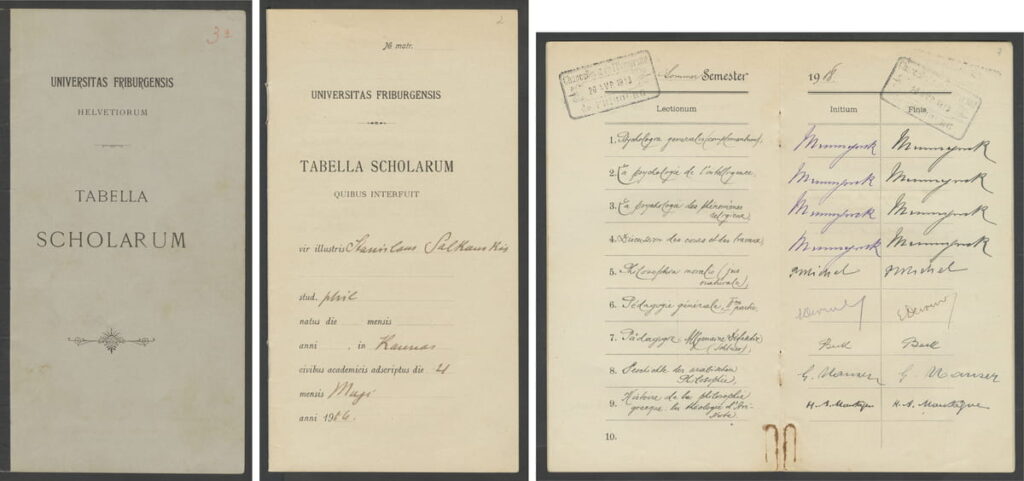
Stasys Šalkauskis’ academic record book from the University of Fribourg. 1916–1919. Vilnius University Library.
The lecturer who made the greatest impression on Stasys Šalkauskis at the University of Fribourg was Professor Marc de Munnynck, who, as can be seen in Šalkauskis’ academic record book, taught him several subjects. Šalkauskis established a friendly relationship with M. de Munnynck and introduced him to Lithuania. M. de Munnynck supported Lithuanian students and contributed to their activities. Šalkauskis maintained contact with his former lecturer after graduating from the university and returning to Lithuania.
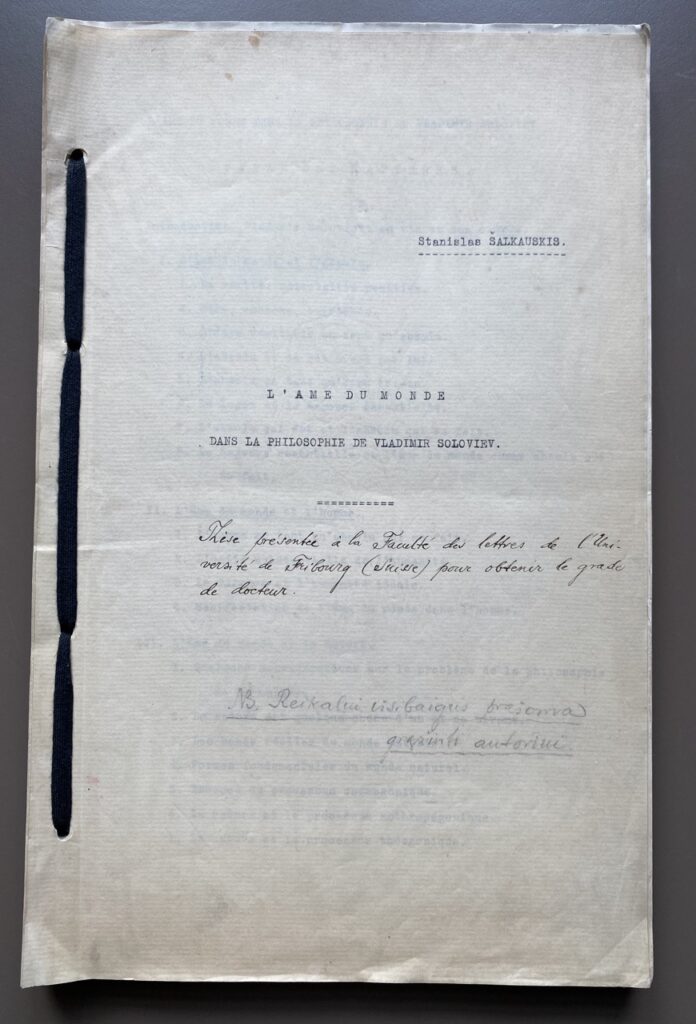
Stasys Šalkauskis’ doctoral dissertation, defended at the University of Fribourg, "The Soul of the World according to the Philosophy of Vladimir Soloviev". 1920. Vilnius University Library.
Šalkauskis defended his doctoral dissertation at the University of Fribourg, titled "The Soul of the World according to the Philosophy of Vladimir Soloviev" ("L’âme du monde dans la philosophie de Vladimir Soloviev"). While still studying in Moscow, Šalkauskis became acquainted with the philosophy of the Russian thinker Vladimir Soloviev. By choosing to examine Soloviev’s philosophy in his dissertation, Šalkauskis sought to reveal the significance of his ideas. Šalkauskis contrasted Soloviev’s ideas with the philosophy of Thomas Aquinas. And Soloviev’s ideas, as Šalkauskis himself acknowledged, did not withstand criticism. Šalkauskis wrote: "I understood the truly infinite power of Aquinas’ logic: from that time on, I have been inclined to regard Thomistic philosophy as the greatest miracle of the human intellect".
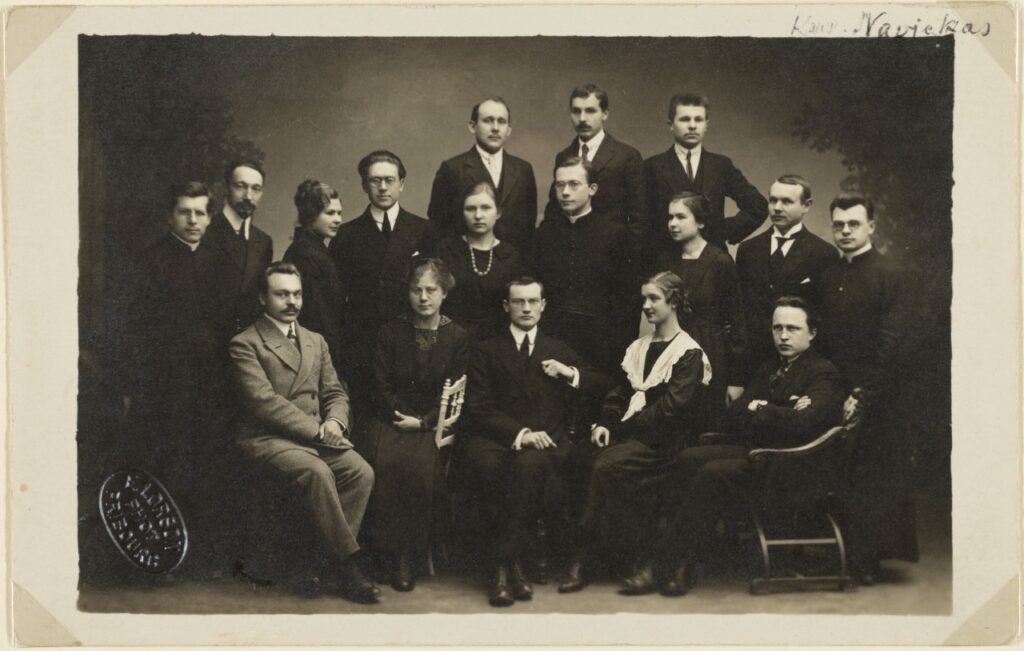
Stasys Šalkauskis (second row, second from the left) among the members of the "Lithuania" student society at the University of Fribourg. 1918–1919
Seated in the first row, from the left: Kazys Pakštas, Marija Andziulytė-Ruginienė, Vincas Mykolaitis-Putinas, Ona Vosyliūtė-Pakštienė, Eduardas Turauskas. Standing in the second row, from the left: Abromaitis, Stasys Šalkauskis, Uršulė Urniežiūtė-Starkienė, Izidorius Tamošaitis, Marija Ambraziejūtė-Kundrotienė, Danielius Žilevičius, Onutė Petrauskaitė-Krikščiūnienė, Pranas Jucaitis, Juozas Navickas. In the third row, from the left: Leonas Bistras, Viktoras Raulinaitis, Klemensas Ruginis. Photographer unknown. Šiauliai "Aušros" museum.
While studying in Fribourg, Šalkauskis met people with whom he remained in contact throughout his life. These included Juozas Eretas, Vincas Mykolaitis-Putinas, Kazys Pakštas, and others. At that time, many young people from Lithuania were studying at the University of Fribourg. Lithuanians in Switzerland were active and gathered in their own societies. One such society was "Lithuania". Šalkauskis was one of the society’s most active members. The members of "Lithuania" prepared for their future work in their homeland.
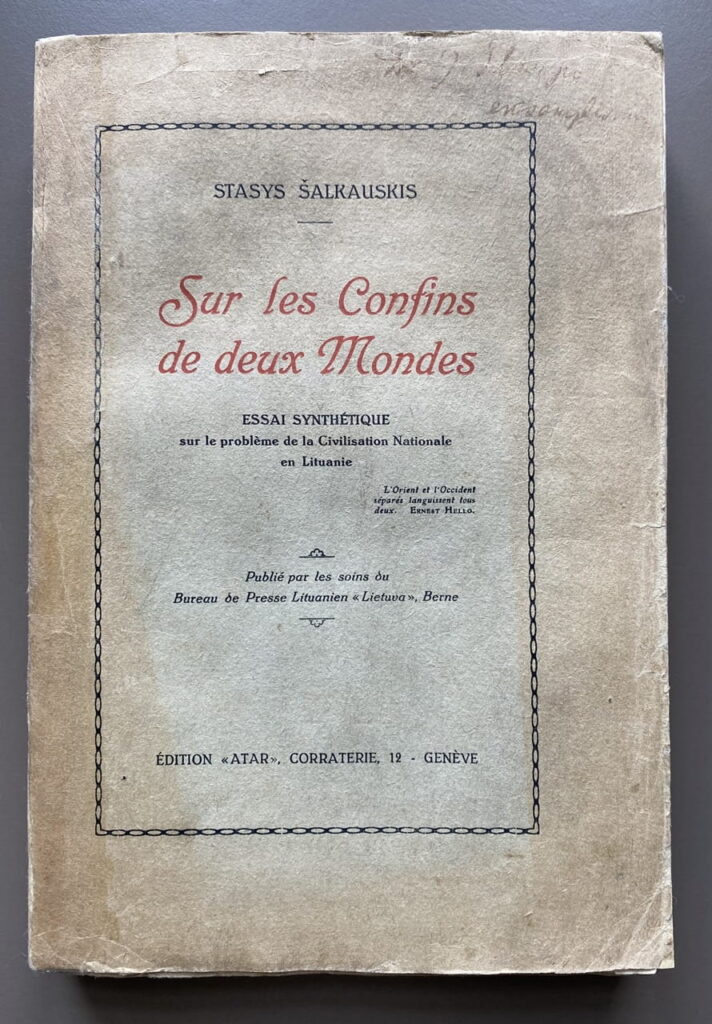
Stasys Šalkauskis’ monograph "On the Boundary of Two Worlds: A Synthetic Essay on the Problem of Lithuanian National Civilisation". 1919. Martynas Mažvydas National Library of Lithuania.
While studying at the University of Fribourg, Šalkauskis wrote the monograph "On the Boundary of Two Worlds: A Synthetic Essay on the Problem of Lithuanian National Civilisation" ("Sur les confins de deux mondes: essai synthétique sur le problème de la civilisation nationale en Lituanie"). In this work, he reflected on Lithuania’s place in Europe and the world, and put forward the idea that the most important task of Lithuanian culture is the synthesis of Eastern and Western civilisations. Lithuania’s mission is to synthesise within itself the principles of these two cultures and maintain their balance. According to Šalkauskis, Lithuanians "live on the border between Eastern and Western Europe and unite within themselves the foundations of these two worlds".